Short-Form Video vs. Long-Form Content: What's Actually Converting in 2026?
The Marketing Industry Has a Content Addiction.
But Conversion? That's a Different Conversation.
In 2026, brands are producing more content than ever before. Reels. Shorts. Podcasts. LinkedIn carousels. Founder videos. YouTube explainers. AI-generated clips. Educational blogs. Community-led storytelling. Attention has become fragmented across platforms, devices, and formats.
Yet one question continues to dominate boardrooms, marketing meetings, and growth discussions:
What is actually converting?
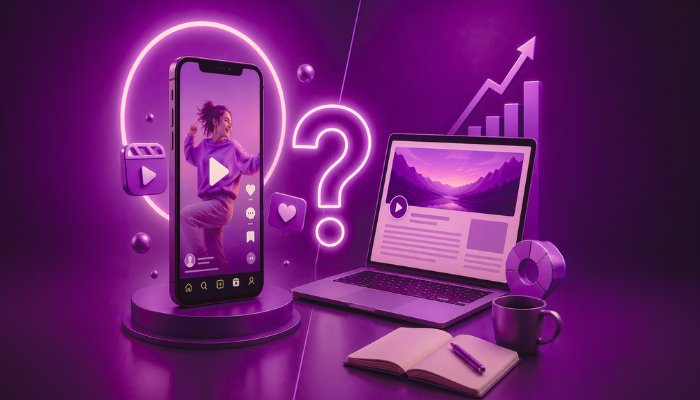
Is it the fast-paced, dopamine-driven short-form video content that dominates algorithms? Or the deeper, authority-building long-form content that creates trust and long-term brand equity?
At TELIVUS MEDIA, we believe the debate itself is flawed.
Because in 2026, the highest-converting brands are not choosing one over the other. They are architecting ecosystems where both formats perform different psychological and commercial roles inside the customer journey.
And the brands that fail to understand this distinction are burning budgets chasing visibility instead of building scalable influence.
The Rise of Short-Form Content: Attention Engineering at Scale
Short-form video became the dominant force because platforms evolved into attention economies.
Instagram Reels. TikTok. YouTube Shorts. LinkedIn snippets. AI-edited vertical content. Every algorithm today rewards speed, engagement velocity, and emotional triggers.
Short-form content excels at:
- Capturing attention instantly
- Driving deep impressions and reach
- Increasing brand discoverability
- Triggering emotional reactions quickly
- Creating repeat visibility
- Encouraging impulse engagement
It is no longer optional.
In 2026, short-form video acts as the digital storefront of a brand.
It is where first impressions are formed. Where audiences decide whether your brand feels relevant, premium, entertaining, trustworthy, aspirational, or forgettable.
But there is a problem many brands are now facing.
Visibility Is Increasing. Conversion Isn't.
Millions of views do not guarantee:
- Trust
- Purchase intent
- Brand loyalty
- Lead quality
- High-ticket conversion
- Retention
This is the illusion many brands are trapped in.
Short-form content is exceptional at generating attention. But attention without depth creates fragile brands.
And consumers in 2026 are becoming increasingly intelligent.
They no longer buy because they saw a Reel. They buy because something validated the Reel afterward.
The Return of Long-Form Content: Trust Is Becoming Premium Again
As digital fatigue increases, audiences are surprisingly shifting their behaviour.
They still consume short-form content constantly.
But before making decisions, they seek:
- Deeper explanations
- Brand credibility
- Founder insights
- Educational breakdowns
- Proof of expertise
- Strategic clarity
- Human storytelling
This is where long-form content dominates.
Blogs, LinkedIn thought leadership, YouTube deep-dives, podcasts, email sequences, whitepapers, case-based storytelling, and educational carousels are now becoming conversion infrastructure.
Long-form content performs differently because it operates psychologically at a different level.
Instead of merely grabbing attention, it:
- Builds authority
- Creates emotional trust
- Reduces buyer scepticism
- Improves SEO visibility
- Nurtures decision-making
- Increases retention
- Positions brands as category leaders
In 2026, long-form content is no longer "slow content." It is high-intent conversion content.
And brands that understand this are quietly outperforming competitors obsessed only with virality.
What's Actually Converting in 2026?
The answer is not short-form OR long-form.
The answer is: Strategic Content Layering
The most successful brands in 2026 use content formats based on funnel psychology.
Short-Form Content Converts:
- Attention into curiosity
- Cold audiences into visitors
- Passive scrolling into engagement
- Brand discovery into awareness
Long-Form Content Converts:
- Curiosity into trust
- Trust into authority
- Authority into buy confidence
- Buyers into loyal communities
One creates an entry. The other creates conviction.
And brands that depend entirely on short-form content eventually struggle with:
- Weak customer loyalty
- High acquisition costs
- Shallow brand perception
- Inconsistent sales cycles
- Algorithm dependency
Meanwhile, brands that rely only on long-form content often struggle with:
- Slow discoverability
- Limited reach
- Reduced cultural relevance
- Lower engagement velocity
The future belongs to brands that integrate both intelligently.
The 2026 Consumer Journey Has Changed
Today's consumer journey is non-linear.
A customer may:
- Discover your brand through a Reel
- Watch a founder interview on YouTube
- Read a LinkedIn article
- Visit your website
- Consume testimonials
- Revisit your social pages
- Read blogs for validation
- Finally, convert weeks later
At every stage, different content formats influence psychological movement.
This means brands must stop measuring content only by:
- Likes
- Reach
- Shares
- Views
And start measuring:
- Trust velocity
- Buyer intent
- Retention influence
- Brand recall
- Conversion quality
- Community depth
- Search visibility
- Customer lifetime value
Because modern conversion is not a single click.
It is accumulated trust.
What TELIVUS MEDIA Makes of This Shift
At TELIVUS MEDIA, we see one major mistake brands continue making in 2026:
They are producing content. But not building content systems.
There is a difference.
Random content creates noise. Strategic content creates market positioning.
We believe:
- Short-form content should function as audience acquisition infrastructure.
- Long-form content should function as authority and conversion infrastructure.
This means every brand needs:
- A visibility strategy
- A trust strategy
- A retention strategy
- A narrative strategy
Not just "daily posting."
The TELIVUS MEDIA Content Philosophy
We approach content through a layered ecosystem model.
1. Short-Form for Attention Domination
We create:
- High-retention Reels
- Scroll-stopping hooks
- Emotion-driven storytelling
- Trend-adaptive creatives
- Fast-paced educational content
- Culture-relevant brand narratives
Purpose: To maximise discoverability and audience entry.
2. Long-Form for Market Authority
We develop:
- SEO-rich blogs
- LinkedIn thought leadership
- Founder positioning content
- Brand storytelling frameworks
- Educational content ecosystems
- Conversion-focused narrative assets
Purpose: To build trust and influence buying decisions.
3. Integrated Funnel Architecture
Most agencies create content in isolation.
At TELIVUS MEDIA, we strategically connect formats.
A Reel becomes:
- A blog topic
- A LinkedIn carousel
- An ad narrative
- A podcast discussion
- An email campaign
- A website conversion asset
This creates:
- Narrative consistency
- Higher retention
- Better brand recall
- Stronger SEO ecosystems
- Reduced content waste
- Lower customer acquisition costs
The Biggest Shift Happening in 2026
The era of "viral marketing" is evolving into the era of trust ecosystems.
Consumers are overwhelmed with content. What they remember now are brands that:
- Educate clearly
- Communicate consistently
- Feel emotionally authentic
- Demonstrate expertise repeatedly
- Build familiarity over time
Virality may get you noticed.
But authority gets you chosen.
And sustainable growth happens when both work together.
Core Reflection
Short-form video is not replacing long-form content. Long-form content is not killing short-form video.
They are becoming interdependent.
One drives reach. The other drives belief.
One wins attention. The other wins the decision.
In 2026, the brands generating the strongest conversions are no longer asking:
"Which format is better?"
They are asking:
"How do we architect content journeys that move audiences from attention to trust to action?"
That is where modern marketing is heading.
And that is exactly where TELIVUS MEDIA positions brands to lead.