Performance Marketing Is Broken Without Brand: The Hidden Cost of Short-Term Thinking
The Performance Marketing Trap
Over the last decade, performance marketing has become the dominant strategy for digital growth.
Brands obsess over metrics such as:
- ROAS (Return on Ad Spend)
- CPA (Cost Per Acquisition)
- CPC (Cost Per Click)
- Conversion Rate
Every campaign is optimised for immediate measurable results.
At first glance, this approach seems efficient and logical.
After all, businesses want predictable revenue from marketing investments.
However, there is a critical problem that many companies fail to recognise.
Performance marketing works best when a brand already has demand.
When companies rely solely on paid campaigns without building brand equity, they eventually face:
- rising advertising costs
- declining conversion rates
- weaker customer loyalty
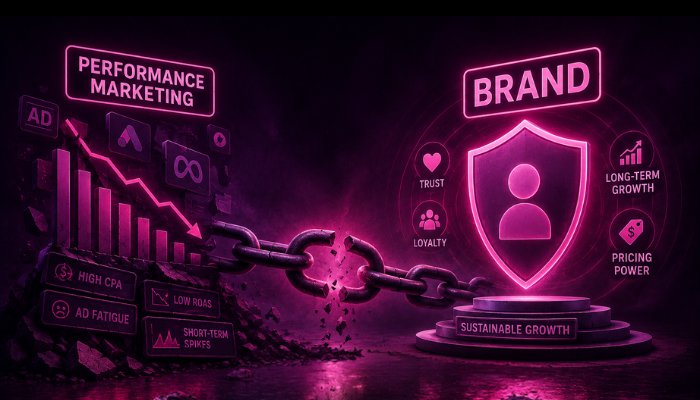
In other words, performance marketing without brand is not a growth strategy — it’s a temporary revenue tactic.
What Is Performance Marketing?
Performance marketing refers to advertising strategies focused on measurable outcomes such as leads, sales, and conversions.
Typical channels include:
- Google Ads
- Facebook and Instagram Ads
- LinkedIn Ads
- Programmatic advertising
- Affiliate marketing
The advantage of performance marketing is immediate visibility and trackable ROI.
Businesses can measure exactly how much revenue each campaign generates.
But this approach also has limitations.
Performance marketing captures existing demand.
It rarely creates new demand.
The Role of Brand Marketing in Business Growth
Brand marketing focuses on building awareness, emotional connection, and long-term trust with customers.
Instead of immediate conversions, branding aims to create mental availability — ensuring that when customers need a product or service, they instinctively think of your brand.
Brand marketing activities include:
- storytelling and brand narratives
- content marketing
- thought leadership
- social media authority
- PR and brand visibility
- consistent visual identity
These activities may not generate instant sales, but they create long-term demand for the brand.
The Core Problem: Performance Marketing Captures Demand, Brand Marketing Creates It
One of the most misunderstood principles in modern marketing is the difference between demand capture and demand creation.
Performance marketing captures existing demand.
Brand marketing creates new demand.
Consider a typical online search behaviour.
When someone searches for:
- “best running shoes online”
- “premium skincare brand”
- “smart home security system”
they are already close to making a purchase decision.
Performance marketing helps brands appear in that moment of intent.
But if consumers do not know your brand, your ads compete purely on:
- price
- discounts
- convenience
This makes marketing increasingly expensive.
The Hidden Cost of Ignoring Brand Building
Companies that focus only on performance marketing eventually experience several structural problems.
1. Rising Customer Acquisition Cost (CAC)
When customers are unfamiliar with a brand, conversion rates drop.
This forces companies to increase ad spend to maintain growth.
As competition increases, platforms like Google and Meta become more expensive.
Without brand recognition:
- CPM increases
- CPC increases
- acquisition costs rise
Brand familiarity significantly improves ad performance.
Consumers are far more likely to click ads from brands they recognise.
2. Declining Conversion Rates
Trust plays a crucial role in consumer decision-making.
Customers prefer brands that feel:
- credible
- familiar
- reputable
Without strong brand perception, performance ads often struggle to convert.
Consumers hesitate because they ask questions such as:
- “Is this brand reliable?”
- “Have others used this product?”
- “Can I trust this company?”
Brand marketing addresses these concerns before the customer even sees the ad.
3. Weak Customer Loyalty
Performance marketing is often transactional.
It attracts customers who are price-sensitive and promotion-driven.
This results in:
- lower retention rates
- weak brand affinity
- frequent switching between competitors
Strong brands, however, create emotional loyalty.
Customers return not only for the product, but also for the experience and identity associated with the brand.
The Compounding Advantage of Brand Marketing
Brand marketing works differently from performance marketing.
While performance campaigns focus on short-term conversions, brand building compounds over time.
A strong brand produces several long-term benefits:
- lower advertising costs
- higher organic search demand
- stronger word-of-mouth marketing
- improved customer retention
This compounding effect creates a self-reinforcing growth engine.
When customers recognise a brand, they are more likely to:
- click on its ads
- trust its messaging
- recommend it to others
As a result, marketing becomes more efficient and scalable.
Why Many Businesses Ignore Branding
Despite its importance, many companies underinvest in brand marketing.
The primary reason is measurement pressure.
Executives often demand:
- monthly revenue growth
- quick marketing ROI
- short reporting cycles
Performance marketing provides immediate data and fast results, which makes it attractive for organisations focused on short-term performance.
Brand marketing, however, requires consistent investment and patience.
But the irony is clear.
Brands that ignore long-term brand building eventually see their short-term performance decline as well.
The Most Effective Marketing Model: Brand + Performance
Modern marketing leaders increasingly recognise that brand marketing and performance marketing must work together.
Instead of choosing between them, successful companies integrate both strategies into a unified growth model.
Brand Marketing (Demand Creation)
- brand storytelling
- social media authority
- thought leadership
- PR and brand campaigns
- content marketing
Performance Marketing (Demand Capture)
- search advertising
- social conversion campaigns
- retargeting
- funnel optimization
This integrated approach allows brands to:
- build awareness
- create trust
- capture demand efficiently
How Strong Brands Improve Performance Marketing Results
Brand strength directly impacts performance metrics.
When brand awareness increases, companies often experience:
Higher Click-Through Rates (CTR)
Consumers are more likely to click ads from brands they recognise.
Lower Customer Acquisition Costs
Trust reduces the friction in decision-making.
Better Conversion Rates
Brand credibility improves purchase confidence.
Higher Lifetime Customer Value
Customers develop loyalty and repeat purchasing behaviour.
This is why the most successful companies treat brand as infrastructure for performance marketing.
The Strategic Shift Happening in Modern Marketing
Leading organisations are moving away from performance-only marketing strategies.
Instead, they are adopting a brand-led performance approach.
In this model:
Brand defines the foundation:
- positioning
- messaging
- identity
- emotional connection
Performance marketing then amplifies the brand story at scale.
The result is:
- stronger campaign performance
- improved marketing efficiency
- sustainable long-term growth
The Real Question Every Business Should Ask
Many companies ask:
“How can we improve our ad performance this quarter?”
But the more important question is:
“Are we building a brand that people want to buy from?”
Because when a brand becomes memorable:
- advertising works better
- customers trust faster
- growth becomes more sustainable.
Brand Is the Infrastructure of Modern Marketing
Performance marketing is an incredibly powerful tool.
But it is not a complete growth strategy by itself.
Without brand building, performance campaigns become:
- expensive
- fragile
- difficult to scale
Brand marketing provides the foundation that makes performance marketing work efficiently.
In today’s competitive digital landscape, the most successful companies do not treat branding as an optional activity.
They treat it as core business infrastructure.
Because when brand and performance marketing work together, marketing stops being a short-term cost — and becomes a long-term growth engine.
Final Thought
If you turned off your advertising tomorrow:
Would people still search for your brand?
If the answer is no, your business may not have a marketing strategy.
It may only have an ad budget.